


Roussillon
Vacation Rentals in Roussillon – Luxury and Charm in Vaucluse
Discover the Ochre and Charm of the Luberon
Roussillon is a picturesque village located in the south of France, known for its colorful house facades and surrounding landscape filled with ochre quarries. It’s a charming place to visit for anyone who appreciates beautiful scenery and typical regional architecture.
To discover
à Roussillon
5 Reasons to Visit Roussillon
Its hilltop village with houses in ochre colors
The ochre quarries located below the village
The nearby Luberon Park and its fantastic panoramas
The local market and its regional products
Its proximity to other villages, such as Gordes and Bonnieux
Roussillon and its ochre: A perfect holiday destination
With the beauty of the nearby Luberon, it’s no surprise that the park and quarries are the village’s main highlights. However, other attractions might also interest you.
Roussillon: The Ideal Village for Unforgettable Summer Holidays

The most obvious place to explore in Roussillon is, of course, the vast Luberon Park. Here, the rocky slopes of the cliffs are a stunning sight to behold, and for good reason: the Luberon holds the largest ochre deposit in the world, and the Gargas quarry is now the last active one in Europe.
From the early workers who toiled with pickaxes and shovels, to those who later used explosives, and even the landscape that continues to evolve today based on the surrounding climate’s harshness, the gorges have so much to show you.
Not far from there is the Conservatoire des Ocres, located in the former premises of the Mathieu company, now closed. Having preserved all its tools and machines, the Conservatoire offers a playful presentation of pigment work and how specific colors can be achieved depending on how the ochre is processed after extraction.
While exploring machines from another era, you can learn everything there is to know about this red rock, which can also be orange, yellow, or even blue!
The Conservatoire also offers seminars, both for schools (from kindergarten to high school) and for individuals interested in learning the almost forgotten art of these “ocriers.”
Luxury vacation rentals in Roussillon – Vaucluse
Discover our selection of vacation rentals in Roussillon, in the heart of Vaucluse, for an unforgettable stay filled with Provençal charm and ochre landscapes.

- 14 pers.
- Heated pool
From
4400€
to
7200€
/ week

- 14 pers.
- Pool
From
6000€
to
9400€
/ week
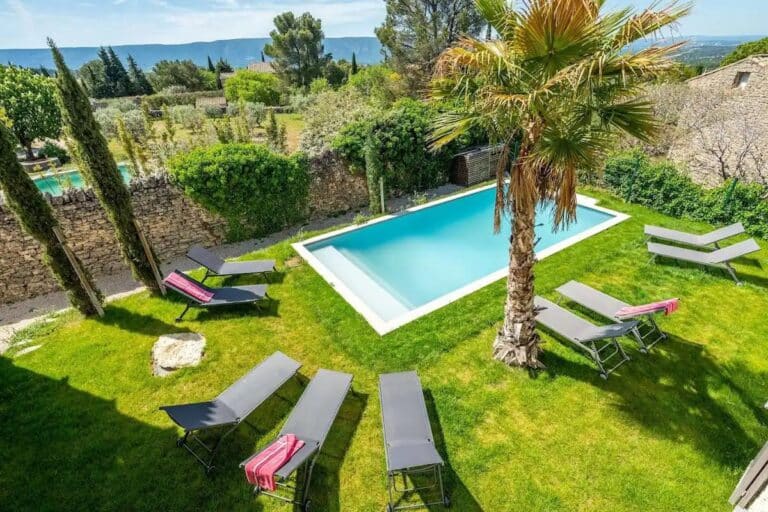
- 10 pers.
- Heated pool
From
3600€
to
6000€
/ week
The Church of Saint-Michel is located within the upper village, behind the town's fortifications. Built around the 10th century, it underwent modifications and various reconstructions from the 11th to the 13th century. The façade visible today dates back to the 17th century.
Dedicated to Saint Michael, the town's patron saint, many artworks inside are listed as cultural heritage, including the Baptismal Fonts. For this reason alone, visiting the church is worthwhile, especially if you find yourself caught in a downpour and need a place to take a break.
The Castrum is the name given to the highest point in the village. Rising over 60 meters, it offers a stunning view of the valley. It's a beautiful hike to take on a sunny morning, before the heat sets in, allowing you to watch the red sun slowly paint the earth in an even more vibrant shade than usual.
Golf Courses Nearby
The golf courses in Provence offer unique settings. The one in Les Baux, nestled in the heart of the Alpilles, stands out for its spectacular views. In Mouriès, Servane captivates with its tranquility between mountains and pine trees. In Avignon, the course combines history and quality, while Pont Royal, designed by Seve Ballesteros, presents a challenging experience in the heart of the region. These locations are must-visits for golf enthusiasts in Provence.

Places to Visit in Roussillon
The village is, of course, known for its colorful facades, picturesque streets, and natural ochres that give it a unique charm. Be sure to keep an eye out for local artisans: these masters of their crafts are always happy and eager to share insights about their unique trades!
Family Vacation
Take the time to stroll through the lower town—or old town—meaning the areas that were not included within the walls of the castrum. These streets, almost all adorned with the characteristic red hue of the village, hold many surprises and are known for their houses dating back to the 17th and 18th centuries.

Romantic Getaway
The belfry, or clock tower, is one of the most visible remnants of the fortifications that once protected the castrum and the surrounding homes. Originally, it was a square guard tower. The modifications still visible today date back to the 19th century: a campanile was added to the top of the tower, and another bell was installed inside. On each side of the tower, a functional sundial is engraved.
Vacation with Your Dog
In the heart of the Luberon, many paths and trails are waiting to be explored, and you can bring your four-legged companion along. We recommend visiting the Étang de la Bonde, a pleasant spot for dogs with plenty of water activities. Surrounded by trees and grass, you can bring a picnic and relax in front of the largest pond in the region.

Getting to Roussillon
The D105 and D169 roads both run alongside the village.
To visit Provence, the most recommended airports are Marseille, Montpellier, and Nice.
Starting from Avignon Centre Station, you can take bus lines 915 and 917 to reach Roussillon. The nearest TGV station is Avignon TGV.
“Les Ocres à Vélo” is a marked route that allows you to explore the Luberon at your own pace and in safety.
Nearby towns to Roussillon

- Joutas: About 4 kilometers.
- Gargas: About 5 kilometers.
- Goult: About 6 kilometers.
- Gordes: About 7 kilometers.
- Saint-Saturnin-lès-Apt: About 9 kilometers.

Time in Provence has selected the best restaurants in the region for you.
Roussillon, History, Traditions, and Culture
**Roussillon, History, Traditions, and Culture**
Since prehistoric times, evidence suggests that the colorful rocks were already used to build sturdy houses. This was certainly the case under the Gaulish tribes. The name Roussillon is believed to come from the Latin name “Ruscilius,” who owned a Gallo-Roman estate in the area.
The earliest record of the city’s name dates back to 989 as “de Rossillione,” indicating that two years earlier, a castrum had been built on a mound.
Ochre from the earth was extracted first with picks and bars, then with explosives. But it was in 1780 that Jean Etienne Astier, a resident of Roussillon, proposed washing the extracted rocks with high-pressure water jets and then drying the resulting clay in tanks. This process allowed him to separate the sand from the pure ochre, which, once dried, could be used as a pigment. Becoming the first ochre producer in France, he amassed a fortune from this activity, extracting up to 40,000 tons in a single year!
But all good things must come to an end: in 1929, the creation of synthetic dyes, which were cheaper and easier to obtain, led to the near-total cessation of extraction, leaving only one company still in operation today.
Although the rocks are stunning to observe, it is strictly prohibited to extract them today due to geological stability concerns.
A well-known sad legend in the Luberon explains why the stones are red: In the 13th century, Dame Sermonde was a beautiful young woman married to the lord of Roussillon, Raymond of Avignon. This man was known to have only one true passion in life: hunting. He would leave the castrum for days, tracking every beast he encountered. Left alone, Dame Sermonde grew fond of a troubadour of the court (or a page and squire, in other versions), Guillaume de Cabestan. The two lovers spent hours together, and the young man wrote many poems for the lady of his heart, their romance becoming increasingly obvious to the servants. Alerted by them, Raymond invited the young man to a hunting party and killed him with a knife in the back. He brought back the heart and ordered his cook to cook it, before serving it to his wife. After the meal, which Dame Sermonde described as the best she had ever eaten, Raymond revealed the horrible truth. Desperate both by the death of her lover and the act her husband had made her commit, the young woman rushed out of the castrum and threw herself from the cliffs of Roussillon. Since then, the rocks have taken on a blood-red hue and have never lost that color. A spring is also said to have sprung up at the exact spot of her death.
