


Raphèle-lès-Arles
At the Gates of Arles
In Raphèles-lès-Arles, you can enjoy the proximity to Arles to visit the arenas or the ancient theater. Alternatively, you can stroll through the village streets to discover the local architecture and taste Provençal cuisine. If you enjoy nature, you might consider biking or hiking in the surrounding area.
To discover
in Raphèle-lès-Arles
5 Reasons to Visit Raphèle-lès-Arles
Its historical and cultural heritage
The variety and beauty of its landscapes
Its local cuisine and regional specialties
Its renowned vineyards in the surrounding area
Its proximity to the city of Arles
On Vacation in Raphèle-lès-Arles
In Raphèles-lès-Arles, you can take advantage of being close to Arles to visit the arenas or the ancient theater. Alternatively, you can stroll through the village streets to discover the local architecture and sample Provençal cuisine. If you enjoy nature, you might consider going for bike rides or hikes in the surrounding area.


Summer Holidays
The most interesting monument in Raphèle-lès-Arles is undoubtedly its church.
The history of this religious building begins even before its construction in 1682. That year, the neighboring church of Moulès opened, forcing the residents to walk nearly an hour to attend sermons. However, due to the small size of the church, the inhabitants of Raphèle-lès-Arles were often forced to stay outside during services, and “this church was still quite far from Raphèle, and the paths connecting the two villages were often in very poor condition.” Thus, the residents requested the construction of a church for their parish towards the end of the 18th century.
The proclamation of the Republic in 1848 was met with some fear regarding the church’s construction; indeed, those now governing the country were the same who had demolished many religious buildings in 1793. Fortunately, the mayor, the Marquis de Grille, was a convinced royalist and a close friend of the White Penitents. The construction of the church officially started in 1850.
Mr. Véran, a member of the Blue Penitents, was chosen as the architect for the project. His first design was magnificent… but it was far too expensive. Unable to find a compromise, a new architect was chosen, Mr. Heraut, who completed the church in 1853 (it cost about 12,000 old francs, which was half the cost of the original project).
The inhabitants were very happy to finally have their own religious building for their parish, even though the building was not very beautiful to look at: no bell tower, bare walls on the outside, and a severe lack of decoration inside. However, in previous years, due to the Revolution, many religious buildings had been forced to close throughout the country, leading to the concealment of many religious objects, safe from the destructive hands of the republicans. An old member of the White Penitents, Aninard, proposed to donate most of the hidden religious furniture from their chapel, so they could be put back to traditional use. Among the religious items donated was a bell from 1819. The following year, finally decorated inside (but still without a bell tower), the church was consecrated, and the first abbot moved into the brand new building. Many village inhabitants continued to offer gifts to the church (paintings, carpets, draperies, fabrics, and even baptismal fonts). Two plots of land adjacent to the church were offered to it, the first in 1854 (allowing the church to add a large cross in front of its portal) and the second in 1856 (to establish the cemetery). A bell tower was finally erected in 1859 and the bell installed inside, all according to the original plans and drawings by Mr. Véran. The church would continue to undergo various transformations in the following years, including the construction of side chapels in 1863 and the addition of stained glass in 1893.
Your vacation home
near Raphèle-lès-Arles
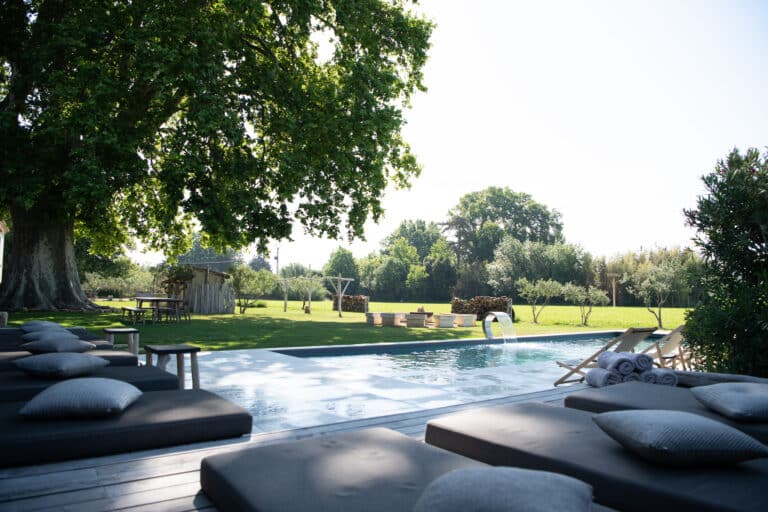
- 12 pers.
- Heated pool
From
8000€
to
11750€
/ week
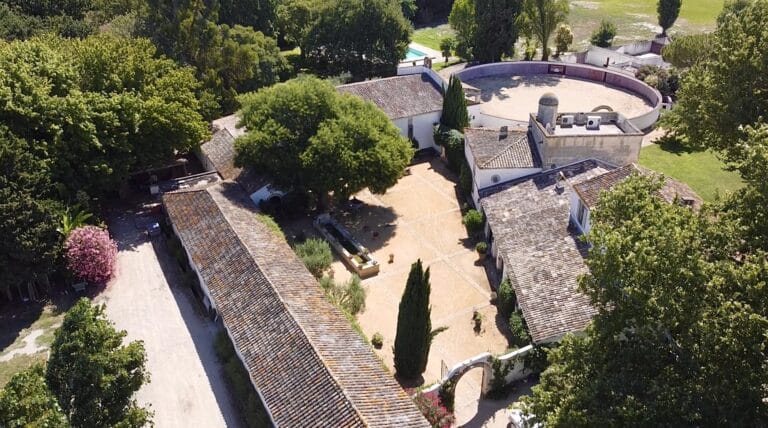
- 22 pers.
- Pool, Fitness
From
9000€
to
13500€
/ week

- 10 pers.
- Heated pool
From
4500€
to
6900€
/ week
Looking to relax? Try the "Au Cœur de Soi" institute and unwind with a yoga class or by receiving a massage.
In the warmer months, come and watch a show at the arenas. Built in the 1980s, they host numerous bull races each year (different from bullfights, as the bull is not killed).
Golf Courses Nearby
The golf courses in Provence offer unique settings. The one in Les Baux, nestled in the heart of the Alpilles, stands out for its spectacular views. In Mouriès, Servane captivates with its tranquility between mountains and pine trees. In Avignon, the course combines history and quality, while Pont Royal, designed by Seve Ballesteros, presents a challenging experience in the heart of the region. These locations are must-visits for golf enthusiasts in Provence.

Places to Visit in Raphèle-lès-Arles
Given its proximity to Arles, most major sites to visit are in the larger city, but there are still a few places in Raphèle-lès-Arles that might interest you.
Family Vacation
For a small family outing, head to Lou Craven farm. There, you can see the Arles Merinos, traditional sheep of the region whose meat and wool are highly valued. The farm also produces Crau AOP hay, a feed recognized as particularly healthy for all livestock.
With the opportunity to see little sheep and kids, small American donkeys, and outdoor play areas for children, the farm has everything you need for an afternoon of fun in direct contact with nature. Don’t forget to give the farm a call beforehand!

Getting to Raphèle-lès-Arles
The small village of Raphèle-lès-Arles is bordered by the D453 road.
To visit Provence, the most recommended airports are Marseille, Montpellier, and Nice.
Starting from the Arles SNCF train station, you can reach Raphèle-lès-Arles by taking the A30 bus line. The nearest TGV station is Avignon TGV.
Thanks to its location in a predominantly rural area, numerous dirt paths invite cyclists to explore them.
Nearby towns to Raphèle-lès-Arles
- Moulès: About 2 kilometers
- Arles: About 9 kilometers
- Fontvieille: About 9 kilometers
- Mas Thibert: About 10 kilometers
- Paradou: About 10 kilometers

Time in Provence has selected the best restaurants in the region for you.
Raphèle-lès-Arles, History, Traditions, and Culture
The history of the village of Raphèle-lès-Arles is relatively obscure (except for the well-documented construction of the church and the building of the arenas, as many who participated in the latter are still alive to tell the tale). It is believed that the hamlet followed the same evolution as its mother city, from which it takes its name (“lès” in old French means “near”). The village began to grow significantly in the 1970s, reaching a population of 2,756 around 2021.
The two main celebrations are the “fête votive” and the annual “Pastrage.”
The “fête votive” takes place on the last full weekend of June and gathers a large number of “attrapaïre.” This term has no known origin, neither in French nor in Provençal. It describes the actions of young men during bull races: while the bulls run through the streets, the attrapaïre tries to grab the bull by the neck and drag it to its knees. A dangerous sport that sometimes ends in the death of a participant (such an incident occurred in 2016 in Vergèze).
The second celebration takes place at the beginning of January (although traditionally, this event occurred around Christmas). First, shepherds and their flocks parade through the streets, followed by musicians and people dressed in traditional attire. After reaching the church to the sound of “galoubets” (a type of flute played with one hand and with only three holes), the priest recites the mass in Provençal, and a young lamb is chosen, carried before the crowd, and blessed. The procession then continues with music and heads toward the town hall.